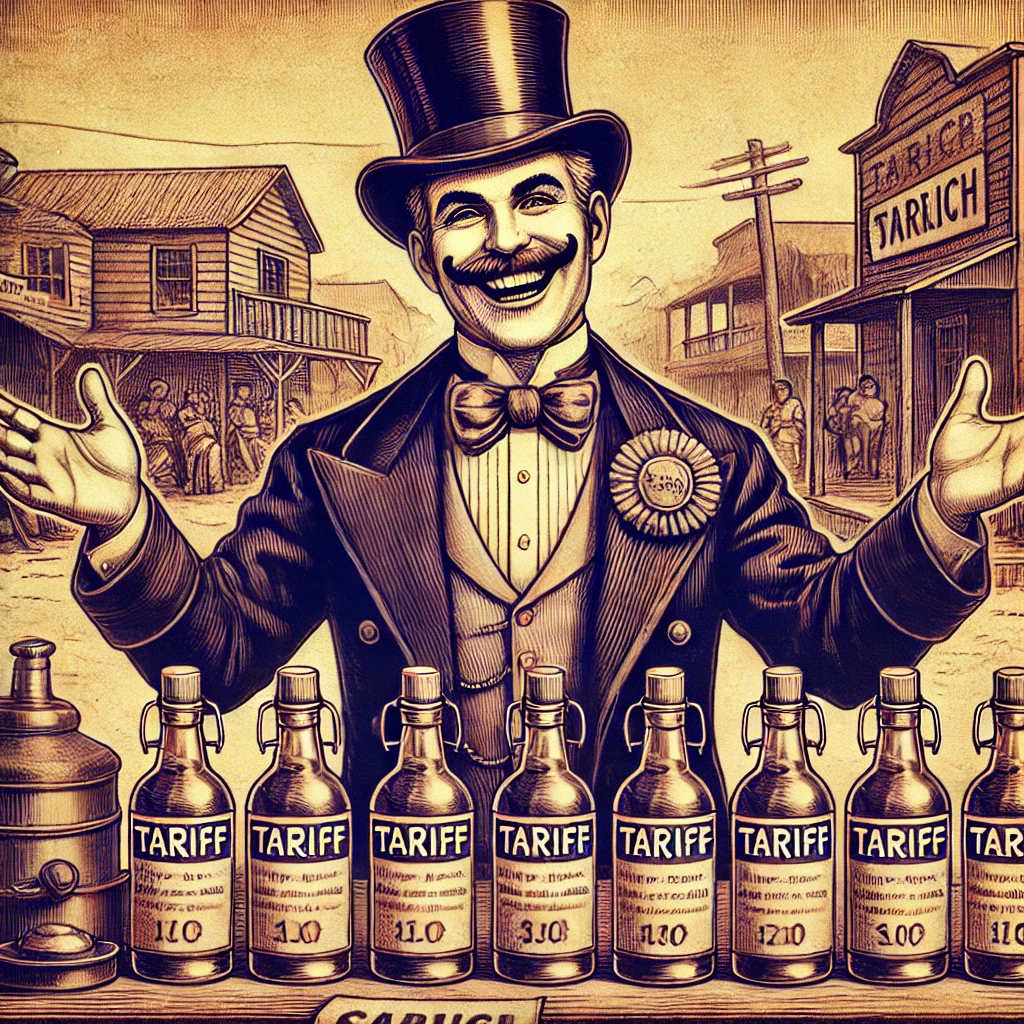
Tariffic!
For the last several months, Trump has really been pushing tariffs as a fix-all for every economic woe.
He initially proposed a 10% tariff on all imports, then later raised it to 20%. More recently, his tariff proposal skyrocketed to 60% and even 100% under certain circumstances. Meanwhile, he has been pounding his fists on his desk and insisting that "These tariffs are paid for by the abusing (exporting) country, NOT THE AMERICAN CONSUMER!!!".
But wait... is that really how tariffs work? Are tariffs paid by the exporter? Typically, no — tariffs are paid by the importer, not the exporter. But, assuming that Trump's words have any meaning whatsoever, the "Trump Tariff" would be paid by the exporter instead.
So, what would this look like? Let's consider what would happen if a 100% "Trump Tariff" was imposed. Pretend that SONY (a Japanese company) sells a single PS5 to Walmart (a US company) for $500. Under Trump's arrangement, SONY would be required to pay a 100% tariff on that sale, which means they would have to pay $500 to the US government. This leaves SONY with a grand total of $0 after the transactions conclude. 🤔
Obviously, this specific arrangement does not make any sense.
Okay, fine. The "Trump Tariff" falls apart at 100%, but surely it can be salvaged if you choose a different percentage! Trump gave us his word that it would save US consumers money while also forcing other countries to fill our coffers! We just need to choose a better percentage, right?
Well, try playing around with the interactive tools below. Perhaps you can figure out some way to make the "Trump Tariff" less costly than a standard Sales Tax. Meanwhile, here are a few other details to keep in mind:
- Tariffs are imposed when goods are imported into the country. This means that their effects will be felt by everyone equally, regardless of where they live. In contrast, Sales Taxes can vary from location to location.
- The median combined Sales Tax in 2024 is 7.00%. This means that half of all locations pay a 7.00% Sales Tax or less.
- The highest combined Sales Tax in 2024 is 9.55%. (Tennessee)
- The lowest combined Sales Tax in 2024 is 0.00%. (Oregon, Montana, New Hampshire, and Delaware)
Alright — have fun trying to figure out how to make the "Trump Tariff" work!
Market Scenario
I chose some default values that really work in Trump's favor due to the imbalance between the Importers's Desired Profit and the Exporter's Desired Profit. Still, feel free to adjust these to see how they impact each of the Taxation Scenarios!
Taxation Scenarios
Click on the scenario that you would like to have explained. This will also recalculate the Δ$ and Δ% quantities so that you can easily compare the other scenarios against the selected scenario.
| Tax Rates | Consumer Cost | ||||||
|---|---|---|---|---|---|---|---|
| Scenario | Import Tax | Sales Tax | Total | Δ$ | Δ% | ||
| Median US Sales Tax + 10% Trump Tariff | 10.00% | 7.00% | $621.19 | $0.00 | 0.00% | 😐 | |
| Median US Sales Tax | 0.00% | 7.00% | $561.75 | ($59.44) | -9.57% | 😁 | |
| Highest US Sales Tax | 0.00% | 9.55% | $575.14 | ($46.06) | -7.41% | 😁 | |
| 10% Trump Tariff | 10.00% | 0.00% | $580.56 | ($40.64) | -6.54% | 😁 | |
| 20% Trump Tariff | 20.00% | 0.00% | $650.00 | $28.81 | 4.64% | 😭 | |
| 60% Trump Tariff | 60.00% | 0.00% | $1275.00 | $653.81 | 105.25% | ☠️ | |
Explanation
Calculating the Exporter's Sale Price
Under the Trump Tariff, the Exporter is responsible for paying the Import Tax. Thus, any profits must be gleaned from the portion of the Sale Price that is Retained after the Import Tax has been deducted.
Furthermore, the Exporter has already invested in the Product, so they will also need to factor this in when calculating the amount of the Sale Price that they need to Retain:
Now that we know the Retention Target, we'll need to work backwards to figure out the corresponding Sale Price. Let's start by converting the Import Tax Percentage into a Proportion so that we can work with it more easily:
The Import Tax Proportion tells us what proportion of the Exporter's Sale Price will need to be paid to the Government as an Import Tax. Its inverse is the Retention Proportion, which tells us what proportion of the Sale Price the Exporter will get to retain after taxes:
We need to choose a Sale Price such that the Sale Price times the Retention Proportion will be equal to our Retention Target. So, if we rearrange the terms, we get:
Huzzah! Next, if we multiply the Sale Price by the Import Tax Proportion, then we get the Import Tax:
Okay, now let's check our work and verify that this Sale Price will allow us to retain our Desired Profit! First, let's calculate our business expenses, which include both the Product's Base Price and the Import Tax:
So, does our Actual Profit match our Desired Profit of $1.00? Let's find out:
Hooray! It all checks out! 🥳
Calculating the Importer's Sale Price
As we saw previously, the Exporter sold the Product to the Importer for $555.56 . Now, the Importer wants to sell the Product to the Consumer and retain a profit of $25.00 . Fortunately, the Importer is not responsible for paying the Sales Tax, which means that they retain the entirety of the Sale Price. This makes the calculation of the Sale Price very straightforward:
Calculating the Consumer Cost
The Consumer wants to buy the Product from the Importer for $580.56, but — NOT SO FAST!!! The Consumer also needs to pay the Sales Tax on the Product! Once again, the first step is to convert the Sales Tax Percentage into a Proportion that we can work with it more easily:
Now we can calculate the Sales Tax:
Finally, the Consumer pays the combined costs of the Sale Price and the Sales Tax:
In Conclusion...
Technically speaking, the Trump Tariff forces the Exporter to pay the tariff. However, the Exporter can trivially cover this expense by raising their Sale Price to account for the tariff. This forces the Importer to purchase the Product at a higher price, which then forces the Importer to sell it to the Consumer for an even higher price. Thus, the Consumer is ultimately the one who pays the tariff.
But, it's actually even worse than that. The Exporter only retains a portion of the Sale Price, which means they only get to keep a fraction of each dollar. To compensate for this, the Exporter needs to increase the Sale Price by more than just their Desired Profit. This means that the Consumer needs to pay even more just so that Exporter can continue earning the same profit that they always earned. Yikes!
In short, the Trump Tariff is just snake oil. It does not work as advertised, and in fact it causes the Consumer more harm than good.